THE GREAT STAGNATION AND THE FAILURE OF BUSINESS INVESTMENT
The myth: Reducing deficits through cuts in government spending will have only modest impacts on total output and employment, and in some cases will actually increase gross domestic product (GDP). This is because businesses and investors will be reassured by painful but necessary measures to repair government finances, and they will become more willing to make long-run investment commitments which will spur economic growth. Moreover, by freeing up both financial and real resources (which otherwise would be absorbed by government deficit-financing), austerity creates economic space for the private sector to assume its rightful, leading economic role.
The reality: Austerity has had large and lasting negative effects on output and employment. Those chilling macro-economic side-effects have undermined the stated goal of deficit reduction (since it’s very difficult to improve fiscal balances in an economy with high unemployment and weak spending)—not to mention imposing painful, multi-generational, human and social consequences. Far from leaping in to fill the economic void left by government retrenchment, business investment has remained lethargic across most OECD countries since the financial crisis. If anything, austerity is undermining the business case for new investments, by so badly undercutting aggregate demand and expected growth.
The inability of most OECD economies to regain robust rates of economic growth since the global financial crisis is glaring and painful proof of the broader failure of austerity policies. The immediate downturn experienced in 2008-09 soon evolved into the ‘great stagnation’: successive years of disappointing growth, unemployment and underemployment, chronic budgetary deficits and historically low wage and price inflation.
One key cause of this sustained weakness has been an unprecedented downturn in capital spending by businesses. Adherents of austerity predicted that private investment would actually lead industrial economies to recovery after the crisis. Invoking the doctrine of ‘expansionary austerity’ (associated with writers such as Alberto Alesina), austerity advocates argued that reducing government deficits (especially through severe spending cuts) would facilitate a business-led recovery. Business confidence would be restored, fiscal and monetary stability would be re-established, and scarce resources would be freed from government’s grasp, quickly channeled into productive private investment. Indeed, from the earliest days of neoliberalism, conservative theorists (such as Robert Barro) emphasized the alleged ‘crowding out’ problem: government spending and borrowing is held to suck up resources which could be used more productively in private investment projects, thus squeezing out private-sector growth. By downsizing government, establishing a more business-friendly policy regime, and stabilizing credit markets, austerity allows business investment to play its rightful role.
But the reality of business-investment performance over the last decade utterly contradicts the neoliberal parable. Business investment across most OECD countries has been shockingly weak since the financial crisis. Figure 1 illustrates the trend in net business capital spending (after deducting depreciation on existing assets) in the OECD. A long-term decline in the pace of net investment was already visible even before the global financial crisis (GFC)—falling from around 12 percent of GDP before neoliberalism, to barely half that pace through the 1990s and early 2000s. After 2008, however, net investment declined sharply, and has not recovered at all. Since then OECD economies on average have allocated just 4 percent of GDP to incremental additions to the private capital stock—one-third the pace of accumulation in the pre-neoliberal era. In an economic system supposedly led by the deep urge of profit-seeking investors to ‘accumulate, accumulate, accumulate’, it is a dire sign indeed that modern capitalists are now hardly growing their real capital stockpile at all.
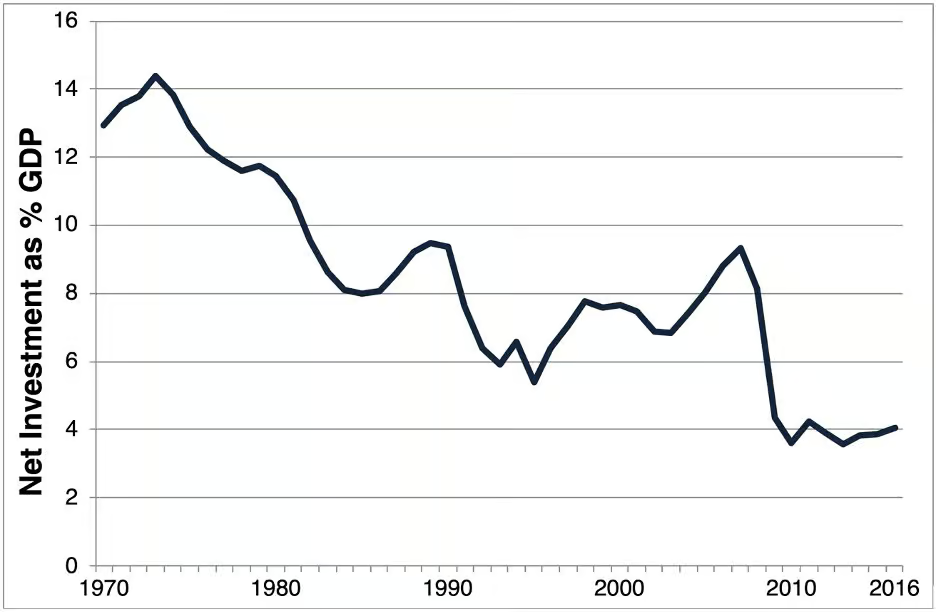
Business capital spending, OECD Countries, 1970-2016. Source: author’s calculations from OECD National Accounts data; unweighted OECD average.
Incredibly, the pace of private investment since the GFC has been so slow that the overall capital intensity of production in many OECD countries is now declining. Capital intensity is measured by the ‘capital-labor ratio’—how much real capital (in all forms, including tools, machinery, technology, structures and so on) is available to supplement the labor effort of workers in production. Rising capital intensity has been the dominant engine of productivity growth and living standards throughout economic history, but now that engine has been thrown into reverse. New capital is being added more slowly than employment is growing; hence the capital-labor ratio is declining in many countries (including the US, Japan and even Germany). This trend poses major risks to future productivity and real incomes. It is especially surprising in light of popular infatuation with the supposed acceleration of automation, robots and other labor-replacing technology: while some industries and occupations have certainly been transformed and disrupted by these innovations, overall investment in new machinery and technology is slowing down, not speeding up.
Yes, belts have been tightened—and business profits have rebounded substantially since the GFC. Business surpluses have regained historical norms in most countries and set new highs in some (notably the US). So the downturn in investment cannot be justified by a shortage of profits or cash flow. (In fact, after-tax corporate cash flow considerably exceeds the pace of reinvestment, creating an accumulation of excess corporate ‘saving’ and facilitating record dividend payouts and share buybacks.) Record-low interest rates for business lending (close to zero in real terms) should also have encouraged more investment. Nor can the investment slowdown be ascribed to a shift in investment to intangible assets (such as technology and software): research-and-development spending has also stagnated across the OECD and declined in many countries.
Capitalism is supposed to be propelled forward, first and foremost, by private investors who accumulate capital, initiate production and generate profits. Their hunger for profit supposedly facilitates output, employment, innovation and productivity—benefits which then should ‘trickle down’ through the rest of society (Ingo Schmidt takes a closer look at the false promise of market populism in chapter eight). There are a few countries where that dynamic is arguably still in play: Korea, for example, continues to record strong business investment, rising capital intensity, rapid innovation, rising productivity and rising wages. Across the OECD as a whole, however, it seems the fundamental ‘engine’ of capitalist expansion is broken. The consequences are very slow growth, continued under-utilization of human and physical resources, fiscal imbalances, and social polarization and conflict. The myth of ‘getting government out of the way’, through spending cuts and other forms of austerity, has foundered on the rocks of macro-economic stagnation.
In retrospect, perhaps the goal of ‘trickle-down’ or ‘expansionary’ austerity was not actually to stimulate more investment and growth. Perhaps the true goal was to redistribute the economic pie—even further in favor of large businesses and the people who own them—rather than to grow it.
Proponents of austerity argue that still more must be done to improve the conditions for business-led growth. They call for continued fiscal austerity to enhance ‘investor confidence’ (even though, in practice, the chilling macro-economic side-effects of austerity on aggregate demand have undermined business capital spending). They demand more business tax cuts (like those implemented in the US under the presidency of Donald Trump), more employer-friendly changes in labor laws and employment standards, and more relaxation of business regulations (including climate policies).
The experience of the entire neoliberal period, however, gives ample reason to reject those demands, and to dismiss the promise that incremental business-friendly policies will somehow finally unleash the dynamic power of private investment which has been so visibly absent. (Other research has confirmed the failure of public-sector austerity and business tax cuts to stimulate business-led growth, including work by Dean Baker; Sarah Anderson and Sam Pizzigati; Alan Auerbach and Yuriy Gorodnichenko; and even new research from the IMF itself, such as by Jamie Guajardo, Daniel Leigh and Andrea Pescatori.) Instead of accepting ever-more-painful demands for belt-tightening and cutbacks in a futile effort to entice capitalists to do what they are supposed to do, this is an opportune historical moment to question the economy’s core dependence on private profit-seeking business investment in the first place.
Since the GFC, public infrastructure spending has already become much more important, largely by default, to the overall process of capital accumulation. Other forms of public and non-profit investment can also be nurtured in many parts of the economy, including in sectors such as housing, energy, utilities, food, and human and caring services, where the irrationality and inadequacy of private-led growth are especially evident. The legitimacy of the traditional ideology that economic progress relies on wealthy elites to make productive, job-creating real investments has been weakened considerably by the failure of private investment in the past decade. A long-term and holistic alternative to austerity must therefore feature, at its core, an alternative vision of how investment can occur—controlled by, and in the interests of, the masses of society, rather than the wealthy few.